Speech of Maharaja Hari Singh at First Round Table Conference
Speech of Maharaja Hari Singh at the First Round Table Conference (1930): Full Text and Historical Significance
Introduction
Among the many important moments in the political history of India during the colonial era, the First Round Table Conference occupies a special place. Convened in London in 1930 by the British Government, the conference aimed to discuss constitutional reforms and the future governance of India.
At this historic gathering, Maharaja Hari Singh represented the princely states as Pro-Chancellor of the Chamber of Princes. His speech remains an important document reflecting the concerns, aspirations, and political maturity of the princely states during a transformative era.
Who Was Maharaja Hari Singh?
Maharaja Hari Singh was the last ruling Maharaja of Jammu and Kashmir and one of the most prominent princes of his time. Educated, reform-minded, and politically aware, he is remembered for introducing several administrative and social reforms in his state.
He played an important role not only in the affairs of Jammu and Kashmir but also in wider Indian politics through his position in the Chamber of Princes.
What Was the First Round Table Conference?
The First Round Table Conference was held from November 1930 to January 1931. It brought together representatives of:
- British India
- Indian princely states
- Various communities and political interests
- The British Government
Its purpose was to discuss constitutional reforms that could lead India toward greater self-government.
The princely states participated actively because any future constitutional arrangement would affect their relationship with British India and the British Crown.
Speech Delivered by Maharaja Hari Singh
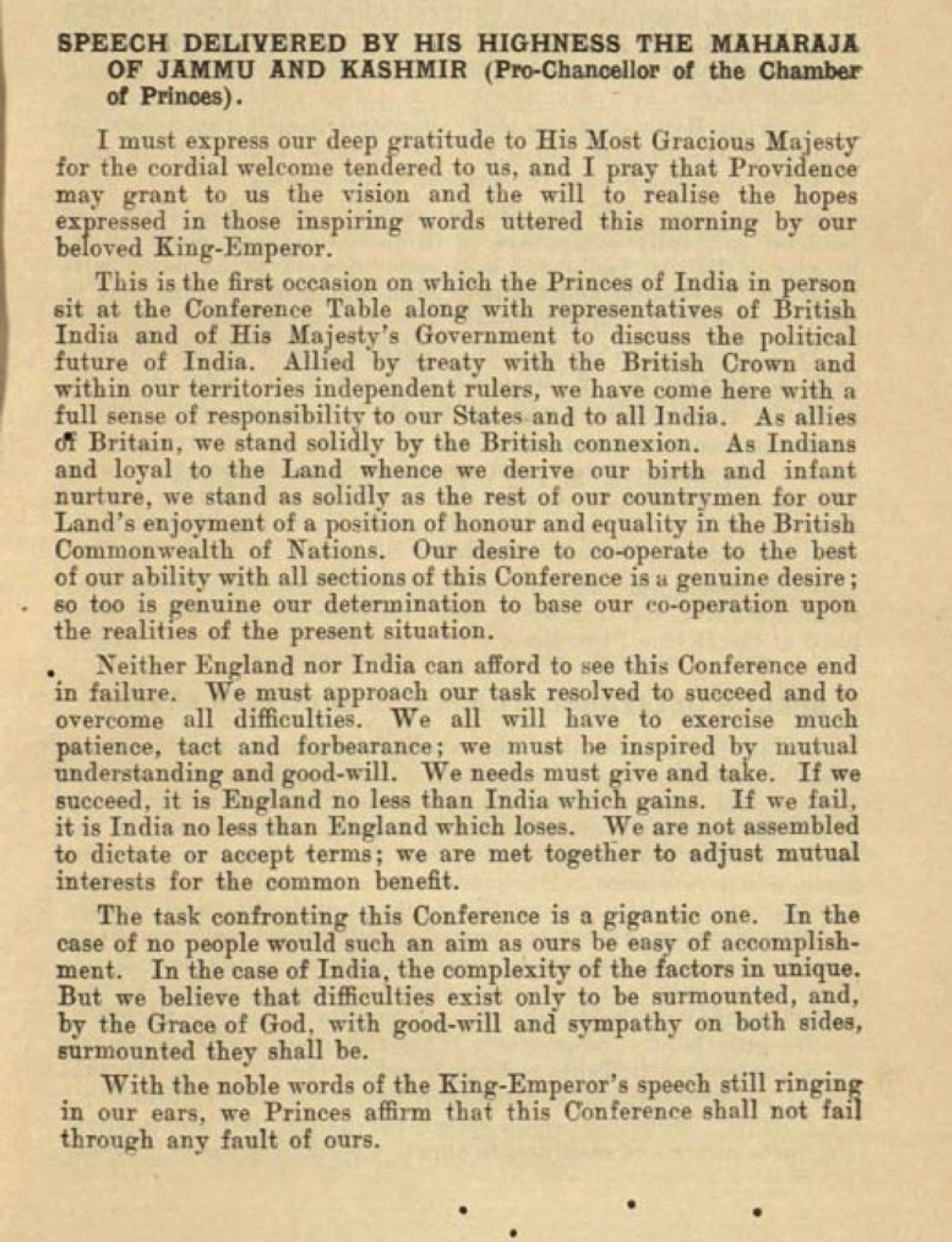
In his address, Maharaja Hari Singh thanked the King-Emperor for the welcome extended to delegates and emphasized the historic significance of princes sitting together with representatives of British India to discuss India’s political future.
He declared that the princes had come with a full sense of responsibility not only to their own states but to all India.
One of the most striking parts of the speech was his assertion that, as Indians, they desired for their land a position of honour and equality among the nations.
He further stated that neither England nor India could afford failure of the conference, and that success required patience, tact, mutual understanding, and goodwill.
The speech concluded with the princes affirming that the conference would not fail through any fault of theirs.
Key Themes and Significance
1. Indian National Outlook
Though a ruler of a princely state, Maharaja Hari Singh spoke in terms of India’s collective future rather than only regional interests.
2. Constitutional Responsibility
He recognized the importance of the conference and the need for serious negotiation in shaping India’s governance.
3. Equality and Honour
His words calling for India’s place of honour and equality reflected growing Indian aspirations in the late colonial period.
4. Role of Princely States
The speech demonstrated that princely rulers were not passive spectators but active participants in constitutional discussions.
Why This Speech Matters Today
For the history of Jammu and Kashmir, this remains one of the most important international political interventions made by its ruler.
For students of Indian history, it reveals the complex role of princely states during the constitutional transition of the 20th century.
For Dogra heritage, it reflects the stature and influence of the Dogra dynasty on the all-India stage.
Conclusion
The speech of Maharaja Hari Singh at the First Round Table Conference was more than a ceremonial address. It was a statement of responsibility, political seriousness, and hope for India’s future.
Today, it stands as a valuable historical document reminding us that leaders from Jammu and Kashmir were participants in shaping debates of national importance.


Comments
Post a Comment