Janjua Rajputs: The Forgotten Warrior Lineage Linking Pothohar and Duggar
By: Udey Veer Anthal
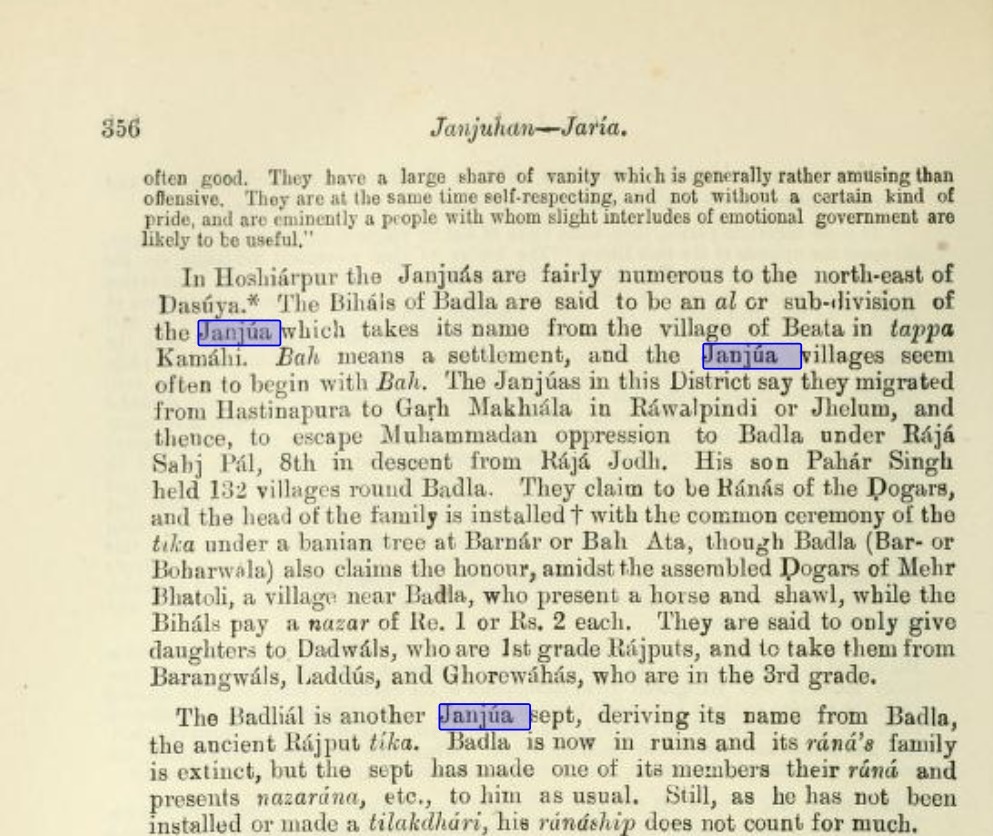 Do you know that the Janjua Rajputs—today widely recognized as prominent Muslim Rajputs of Pakistan-administered Kashmir—also had a historical presence in regions like Poonch, Rajouri, and adjoining parts of Duggar? Though they are not counted among the core Dogra Rajput clans such as the Jamwal Rajputs or Manhas Rajputs, their history forms an important bridge between the cultural worlds of Pothohar and the Duggar frontier. Drawing upon the detailed ethnographic account of H. A. Rose in A Glossary of the Tribes and Castes of the Punjab and North-West Frontier Province, the Janjuas emerge not as a marginal tribe, but as a once-powerful and deeply rooted political community whose influence extended across regions that today lie divided by borders but were historically interconnected.
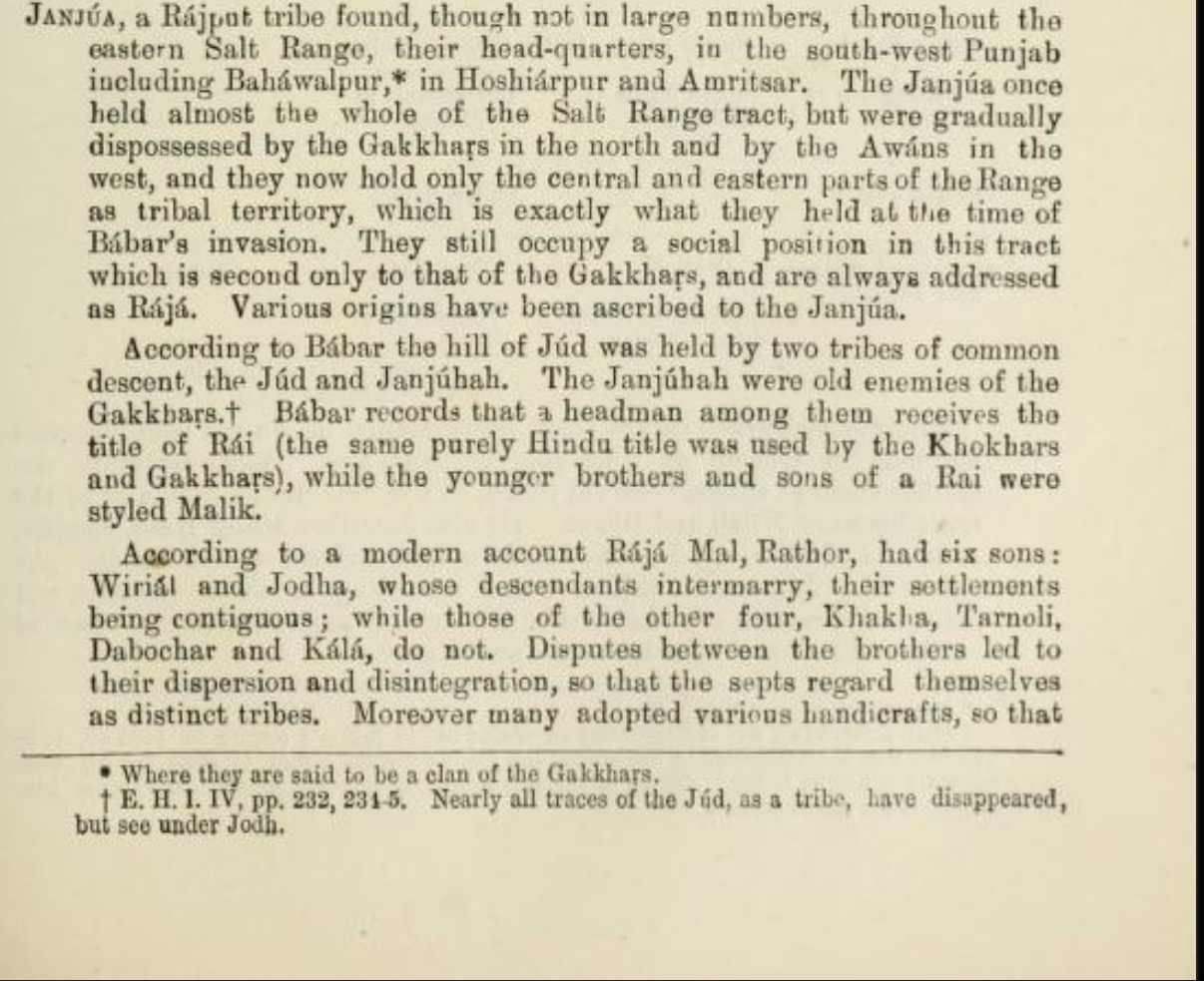
In Rose’s account, the Janjuas are primarily located in the Salt Range, which appears as their ancestral heartland and political base. He notes that they were once in possession of almost the entire tract of this strategically important region, suggesting that they were not merely inhabitants but dominant rulers who exercised considerable authority. However, like many frontier powers, their control gradually eroded under pressure from neighboring tribes. The Gakkhars in the north and the Awans in the west encroached upon their territories, reducing the Janjuas to holding only the central and eastern parts of the Salt Range. Yet even in this reduced condition, they retained a high social standing, being ranked just below the Gakkhars and consistently addressed with titles such as “Raja,” which indicates the persistence of their aristocratic identity despite political decline.
The historical depth of the Janjuas is further reinforced by references attributed to early sources such as Babur, who mentions tribes like the Jūd and Janjūhah inhabiting the Salt Range hills. These references suggest that the Janjuas were already established as a distinct and politically organized group by the early sixteenth century, if not earlier. Their rivalry with the Gakkhars, as noted in these traditions, reflects the competitive and often violent nature of frontier politics in this region. The use of titles like “Rai” for chiefs and “Malik” for their kin further points to an internal hierarchy that combined elements of tribal organization with quasi-feudal authority, giving the Janjuas a structured and stratified social order.
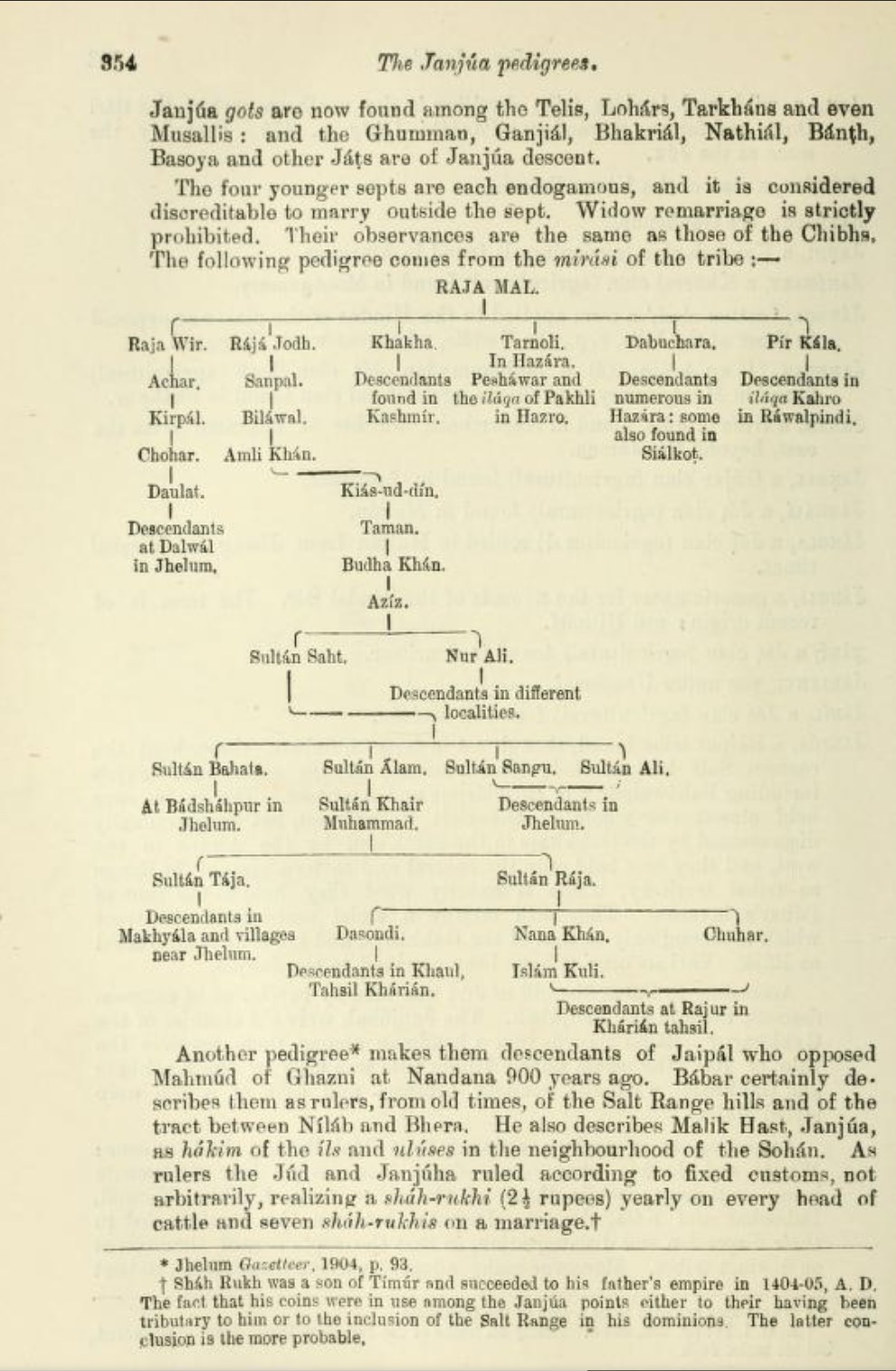
One of the most detailed aspects of Rose’s work is his account of Janjua genealogy, which traces their lineage to a figure named Raja Mal. From him descended multiple branches, including those of Wir, Jodh, Khakha, Tarnoli, Dabochara, and Kala. Over time, disputes among these branches led to their dispersal and fragmentation, resulting in the formation of distinct septs that began to regard themselves as separate tribal units. This process of internal division is significant because it explains how a once unified ruling clan gradually transformed into a network of related but autonomous groups spread across different regions. The genealogical tables also indicate their geographical spread, with descendants found not only in Jhelum and Rawalpindi but also in Hazara and even parts of Kashmir, particularly in areas like Pakli. This clearly situates the Janjuas within a broader cultural zone that overlaps with the Duggar region, especially in its western fringes.
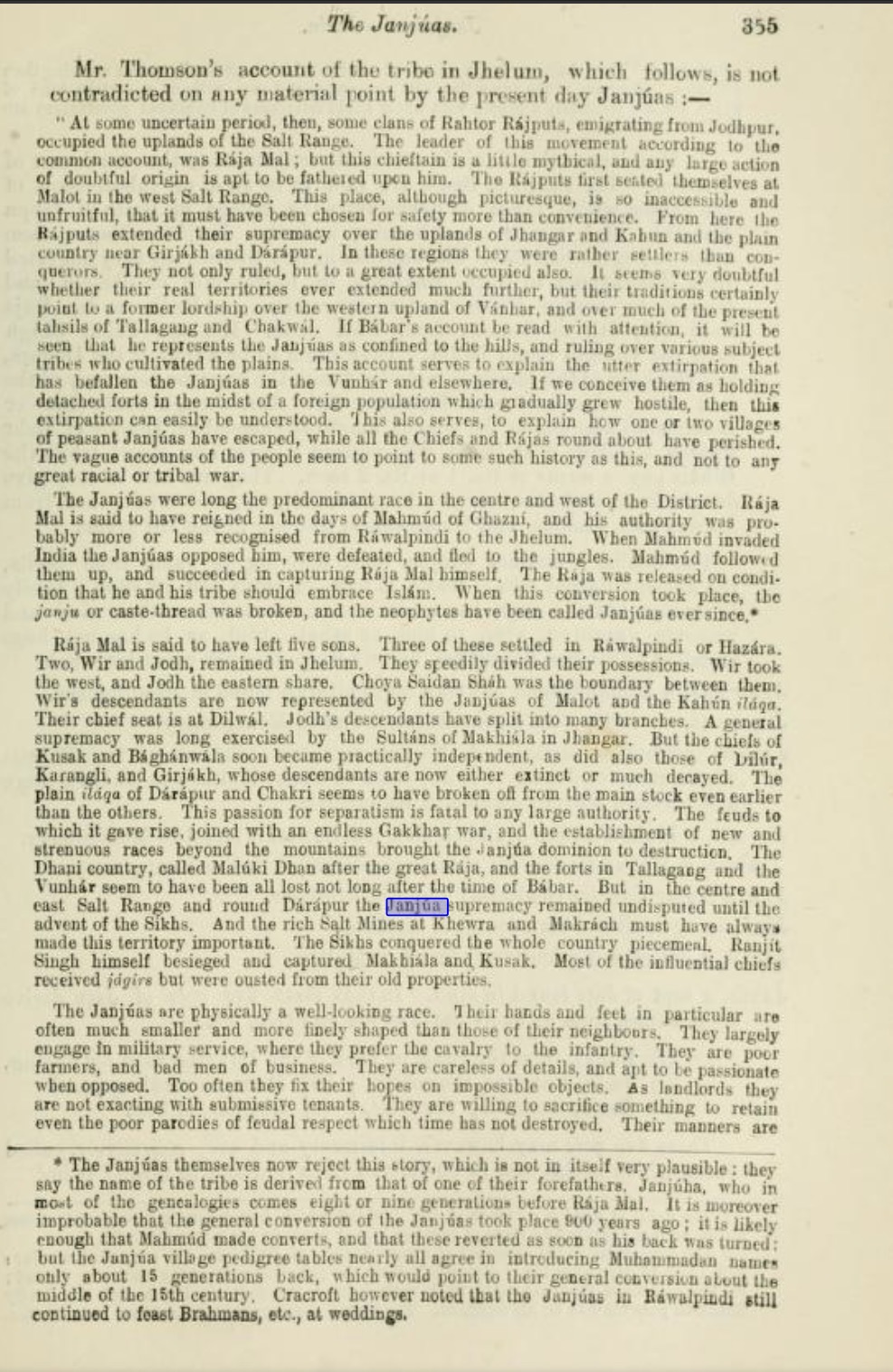
A crucial transformation in Janjua history, as recorded by Rose, is their conversion to Islam. While some traditions link this event to the time of Mahmud of Ghazni, the evidence presented in genealogies suggests a later and more gradual process, likely occurring around the fifteenth century. This conversion marked a significant shift in their religious identity, symbolized by the abandonment of the sacred thread, yet it did not erase their sense of Rajput lineage. Even after embracing Islam, the Janjuas retained their clan structure, titles, and marriage customs, continuing to practice endogamy and uphold notions of aristocratic descent. In the present day, they are found predominantly as Muslim Rajputs across Punjab and Pakistan-administered Kashmir, where they maintain a strong sense of historical identity rooted in their Rajput past.
Rose’s observations also reveal the social complexity of the Janjuas, noting that over time, individuals and groups associated with them came to be found among various occupational communities such as Telis, Lohars, and Tarkhans, as well as among certain Jat groups. This indicates a degree of social fluidity and adaptation that challenges the rigid perception of caste and tribe. Rather than remaining a closed and unchanging entity, the Janjuas appear to have interacted with and influenced a wide range of social groups, leaving traces of their identity in diverse contexts. At the same time, their own internal customs remained conservative in certain respects, with strict rules regarding marriage and the prohibition of widow remarriage, aligning them with broader Rajput traditions.
The traditions recorded by Rose also connect the Janjuas to a wider Rajput narrative by linking them to Rathor origins from Jodhpur, with a migration led by Raja Mal into the Salt Range. While such accounts carry a legendary dimension and must be approached critically, they reflect the Janjuas’ own understanding of their past and their desire to situate themselves within the prestigious framework of North Indian Rajput genealogy. This blending of history and tradition is characteristic of many Rajput clans and adds another layer to the complex identity of the Janjuas.
The decline of Janjua political power appears to have been a gradual process shaped by multiple factors, including internecine conflicts, pressure from rival tribes like the Gakkhars, and the rise of new political forces in the region. By the time of the Sikh expansion under Maharaja Ranjit Singh, their dominance had already been significantly weakened, and although some chiefs retained local influence, the era of their widespread control had come to an end. Nevertheless, their legacy persisted in social status, cultural memory, and the continued use of honorific titles.
Even the physical and behavioral descriptions provided by Rose, though reflective of colonial ethnographic biases, contribute to the image of the Janjuas as a martial and self-conscious community. They are described as well-built, inclined toward military service, and possessing a strong sense of pride and self-respect. Such portrayals, while not free from subjectivity, align with the broader characterization of Rajput groups as warrior elites.
In conclusion, the Janjua Rajputs represent a fascinating example of how identity in the Duggar–Punjab frontier evolved over time. Their history, as preserved in A Glossary of the Tribes and Castes of the Punjab and North-West Frontier Province, reveals a journey from regional dominance in the Salt Range to dispersion across multiple regions, from a Hindu Rajput lineage to a predominantly Muslim Rajput identity, and from political power a more symbolic social prestige . Although they do not form part of the core Dogra Rajput framework, their presence in areas like Poonch and their deep connections with adjoining regions make them an integral, if often overlooked, component of the wider historical tapestry of Duggar.


Comments
Post a Comment