Before the Treaty of Amritsar 1846: How the Dogras Built the Foundations of a State
By: Udey Veer Anthal
The history of Dogra rule in Jammu and Kashmir is often associated with the Treaty of Amritsar, through which Gulab Singh became the Maharaja of the newly created princely state of Jammu and Kashmir. In popular memory, 1846 is usually treated as the beginning of Dogra power. Yet, a closer examination of nineteenth-century records reveals a very different picture. Long before the Treaty of Amritsar, the Dogras had already laid the foundations of a powerful regional state through territorial expansion, military campaigns, strategic alliances, and the gradual consolidation of revenue-producing estates across Jammu and the adjoining hill regions.
Rare records of Gulab Singh, Dhian Singh, and Suchet Singh provide remarkable insight into this process of state formation. These records are not merely lists of jagirs; they are documentary evidence of how the Dogra brothers accumulated territory, wealth, and political authority decades before 1846. They show the transformation of the Dogras from regional nobles into state builders.
An especially important detail appears in the record concerning “Chini,” which is actually Chenani. It is worth mentioning here that the territory was restored to Raja Dayal Chand as jagir after he visited the Lahore Darbar and met Maharaja Ranjit Singh. He was thereafter permitted to reside in his state and the state was ruled by his descendants till 1947. This small but significant reference reveals the complex political negotiations taking place in the Jammu hills during this period, where local rulers, the Lahore Darbar, and the rising Dogra elite constantly interacted within shifting structures of authority.
Gulab Singh and the Economic Foundations of Power
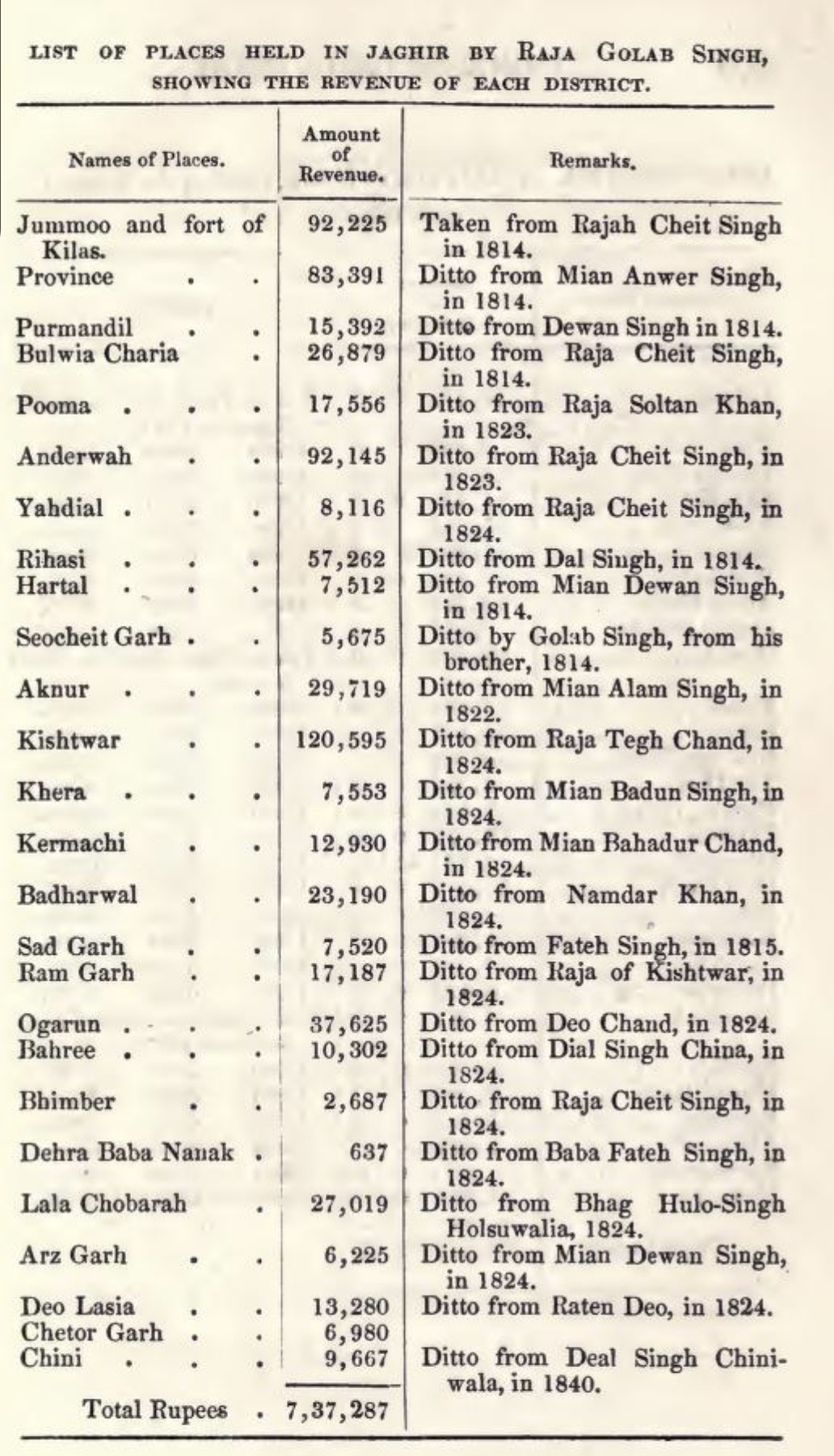
The revenue table relating to Gulab Singh is perhaps the most important among the records. It demonstrates how, between 1814 and 1840, he gradually accumulated a vast network of territories and revenue estates. The table records jagirs yielding a total annual revenue of approximately Rs. 7,37,287 — an enormous amount for the period and a clear indication of the economic foundations upon which later Dogra sovereignty would rest.
The records show that Jammu and the fort of Kilas were taken from Raja Chet Singh in 1814. This was one of the earliest major steps in the consolidation of Dogra authority in the Jammu region. Similarly, Kishtwar was taken from Raja Tegh Chand in 1824. These entries reveal that Dogra expansion was not abstract or symbolic; it involved the systematic incorporation of specific hill principalities and strategically important territories into a growing political structure.
Other estates mentioned in the records include Reasi, Akhnoor, Krimchi, and several smaller hill tracts that collectively strengthened Dogra control over the Jammu hills. The remarks column in the table is particularly valuable because it identifies the previous holders of these territories, thereby preserving traces of the older political order that gradually disappeared under Dogra expansion.
The significance of these records lies not only in territorial acquisition but also in administration. Every newly acquired region was transformed into a revenue-generating unit. This demonstrates that Gulab Singh was not merely a military commander or jagirdar; he was actively constructing the economic infrastructure necessary for durable state power. By the time of the Treaty of Amritsar in 1846, much of the administrative and financial groundwork of the future princely state had already been established.
Dhian Singh and Political Authority at Lahore
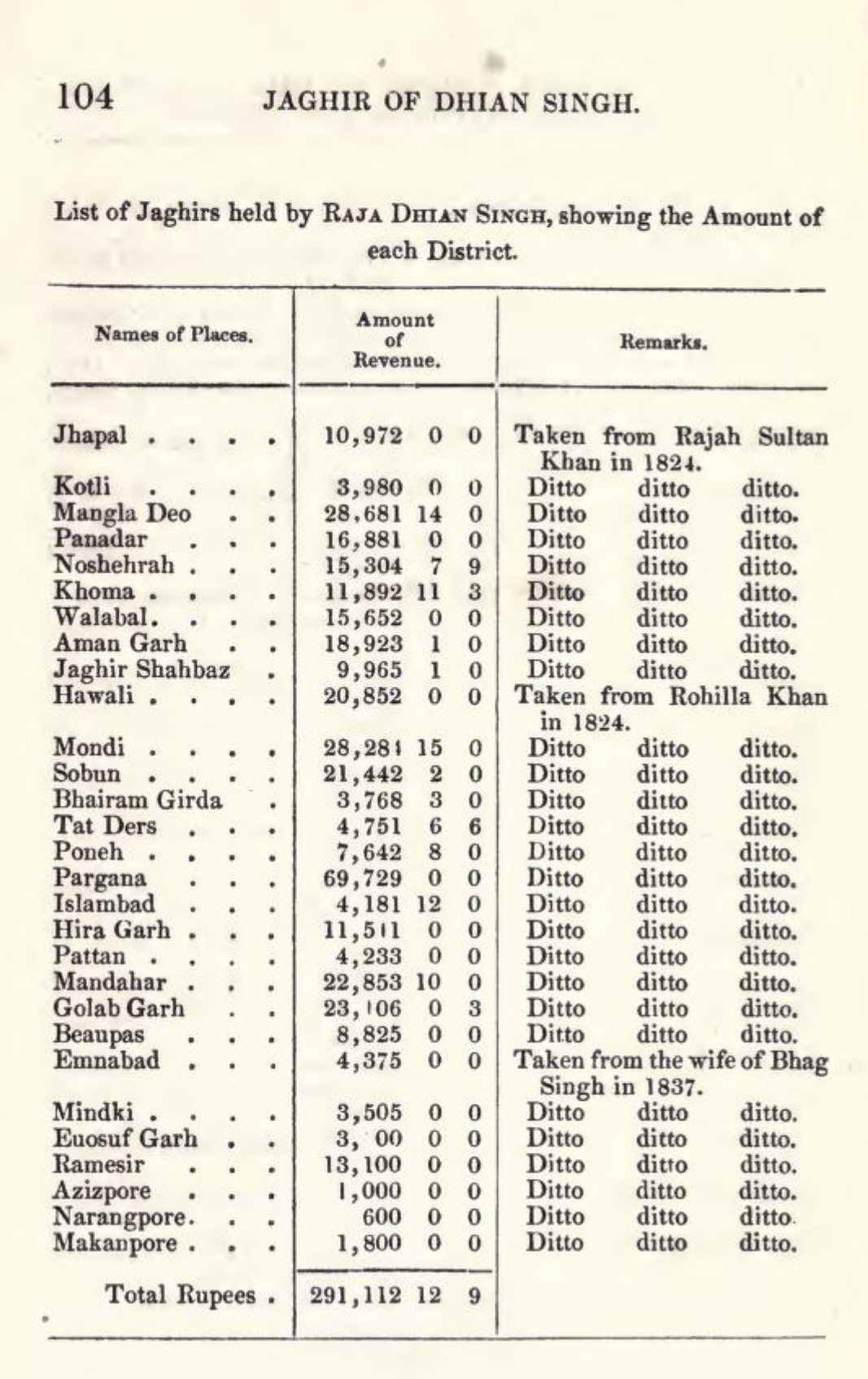
The records concerning Dhian Singh are equally significant. His jagirs produced an annual revenue of approximately Rs. 2,91,112 and reflected his extraordinary political position within the Lahore Darbar. Unlike Gulab Singh, whose authority was rooted primarily in territorial consolidation in the hills, Dhian Singh represented Dogra influence at the center of imperial politics.
As one of the most powerful nobles at Lahore, Dhian Singh played a crucial role in strengthening the political standing of the Dogra family. His estates and privileges illustrate how the Dogras successfully combined regional authority with influence at the imperial court. This dual strategy enabled them to expand their territorial control while simultaneously securing political legitimacy within the broader power structure of northern India.
The records associated with Dhian Singh further demonstrate that the rise of Dogra power was not accidental. It was supported by a carefully developed network of jagirs, administrative authority, and political patronage. Together, the three brothers accumulated vast resources that would later enable Gulab Singh to emerge as the ruler of one of the largest princely states in the subcontinent.
Suchet Singh and the Expansion of Dogra Influence
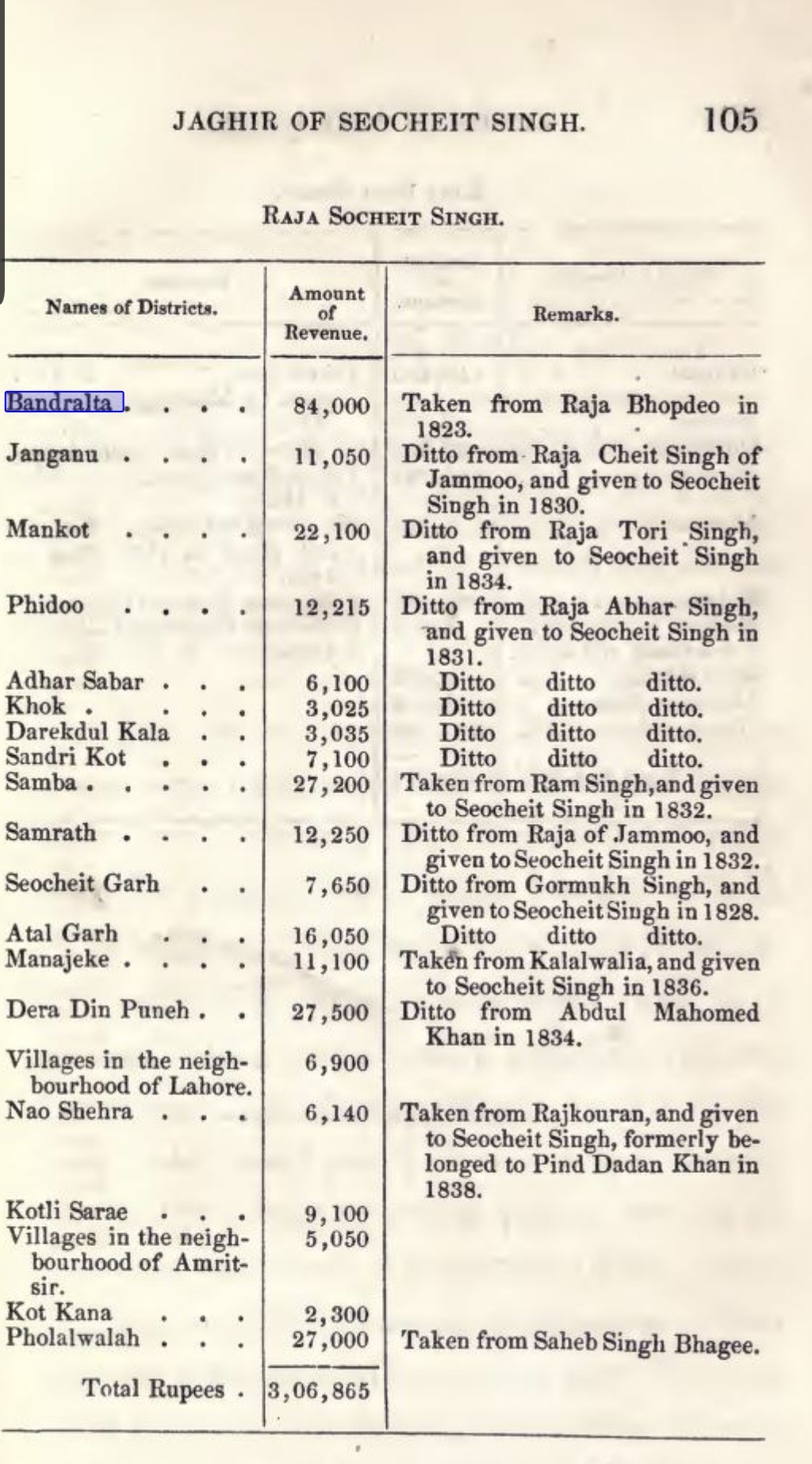
The records of Suchet Singh reveal another dimension of Dogra power. His jagirs yielded an annual revenue of approximately Rs. 3,06,865, reflecting the enormous influence exercised by different branches of the Dogra family. These estates included territories spread across Jammu and adjoining regions, illustrating how Dogra authority was not concentrated in a single domain but distributed through a wider familial and political network.
The records demonstrate that Suchet Singh controlled strategically important territories that strengthened the collective position of the Dogras within the hill states and the Lahore Darbar. Through these jagirs, the Dogra elite acquired both wealth and influence, enabling them to maintain armed retainers, establish local authority, and expand their political reach.
These estates also reveal the importance of kinship in the rise of Dogra power. The Dogra brothers did not operate as isolated individuals; rather, they functioned as a coordinated political network whose combined territorial possessions gave them immense leverage in northern India. The accumulation of jagirs under different members of the family allowed the Dogras to consolidate influence across multiple regions simultaneously.
Conclusion
These rare records fundamentally reshape our understanding of Dogra history. They reveal that the foundations of the princely state of Jammu and Kashmir were laid long before the Treaty of Amritsar in 1846. By the time Gulab Singh formally became Maharaja, the Dogras had already spent decades building economic strength, absorbing local chiefships, consolidating hill territories, and establishing political dominance across the region.
The documents show that the Dogras were not merely recipients of a kingdom through diplomatic agreement. They were active state builders who transformed military success and jagirdari grants into a structured political order. Through conquest, administration, and revenue consolidation, the Dogra brothers created the foundations of a state whose influence would shape the history of Jammu and Kashmir for generations.


Comments
Post a Comment