1888 & 1890 Jammu and Kashmir Railway Agreements (Jammu-Sialkot line): History, Politics and Impact
How the 1888 and 1890 Jammu and Kashmir State Railway agreements reveal the politics of empire, princely authority, and the making of modern connectivity.
By: UDEY VEER ANTHAL
There are moments in history when a region changes not with a battle, a coronation, or a proclamation, but with a contract. In the case of Jammu and Kashmir, one such moment came in the late nineteenth century, when the future of the state’s first railway connection was worked out not on the platform of a station but in the clauses of two agreements—one signed in July 1888, the other in November 1890. Together, these documents did more than authorize the construction of a line between Sialkot and Jammu. They mapped an entire political relationship between princely ambition and imperial power, between local sovereignty and colonial standardisation and between the geography of the Dogra state and the infrastructure of British India.
The railway that emerged from these agreements—the Jammu–Sialkot line—was modest in length but immense in meaning. It was the first railway line in the princely state of Jammu and Kashmir, a 27-mile broad-gauge link that connected Jammu with Sialkot and, through Sialkot, with the wider North Western Railway system of British India. Built between 1888 and 1890 during the reign of Maharaja Partap Singh, it gave the state a new relationship with distance, mobility, administration, and commerce. Yet to focus only on the line itself is to miss the deeper story. The real historical drama lies in the agreements that made it possible.
Those agreements deserve to be read as texts of statecraft. They tell us how railways entered princely India; how the British Government of India negotiated with a ruler whose state was formally autonomous in internal matters but embedded in an unequal imperial order; how finance, jurisdiction, maintenance, fares, revenue, ceremonial privilege, and territorial authority had to be sorted before the first sleeper could be laid. The 1888 agreement laid down the original architecture of the project. The supplementary agreement of 1890 revised that architecture when experience, practicality, and fiscal logic demanded adjustment. Read together, they illuminate not merely a railway enterprise, but the texture of colonial modernity in northern India.
A frontier state in an age of railways
By the late nineteenth century, railways had become one of the defining instruments of British power in India. They accelerated troop movement, tightened administrative command, enlarged markets, and made the reach of the colonial state more immediate and more material. Across the subcontinent, rail lines were not simply transport systems; they were political technologies. They reduced the friction of distance, integrated regions into larger circuits of power, and altered how states imagined space itself.
Jammu and Kashmir occupied a special place in that world. Ruled by the Dogra dynasty, the state was geographically vast, strategically sensitive, and difficult to access. Its mountains, river systems, climate, and distances posed obvious challenges to movement. Jammu, the winter capital, sat closer to the plains, but the state as a whole remained less connected than the rapidly transforming railway districts of Punjab. As the railway map of northern India thickened, Jammu and Kashmir could not remain untouched by the question of connectivity.
For the Dogra rulers, the case for a rail link was practical and political at once. Better transport promised easier movement of officials, supplies, and commercial goods. It offered quicker access between the state and Punjab. It could strengthen administration, stimulate trade, and enhance the prestige of the ruler by placing his state within the visible architecture of modernity. For the British, meanwhile, such a line had obvious strategic value. A railway reaching Jammu would improve communications toward a politically important frontier state and fold that state more tightly into the transport system of imperial India.
This shared interest did not mean equality of power. The British Empire and the Dogra state approached the railway from different positions and with different capacities. But the project that followed was not simply imposed by one side upon the other. It was negotiated. That is what makes the 1888 and 1890 agreements so revealing. They show how empire often advanced not only by decree but through documents that carefully translated unequal relationships into precise administrative language.
Before the train, the document
The Jammu–Sialkot line did not begin with locomotives. It began with a legal imagination. Historical accounts note that the line was constructed as an extension of the Wazirabad–Sialkot line, itself built in the early 1880s, and that the initiative came from the Maharaja’s government. Maharaja Ranbir Singh is said to have written to the Governor-General with an offer to fund the construction; after his death, Maharaja Partap Singh carried forward the negotiations that culminated in the formal agreement. This succession matters. It suggests that the project belonged to a larger state vision rather than a passing administrative experiment.
By the time the formal agreement was signed in July 1888, the railway had already become a shared object of calculation. How should the line be named? Who would bear the capital cost? Who would build it? Who would operate it? What would happen to earnings? Which authority would exercise jurisdiction over railway land within a princely state? How would the dignity of the Maharaja be represented in an institution premised on standardized rules? These were not secondary questions. They were the project.
The attached agreement pages make this unmistakable. The railway was not treated as a generic public work. It was a carefully bounded legal and fiscal arrangement, negotiated point by point. In that sense, the agreements are more than supporting material for the railway’s history. They are the core of that history.
The 1888 agreement and the making of a state railway
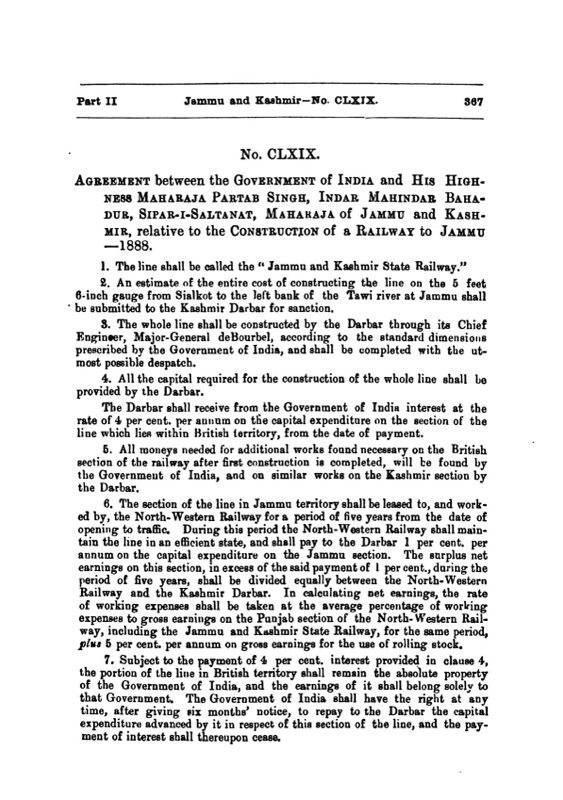
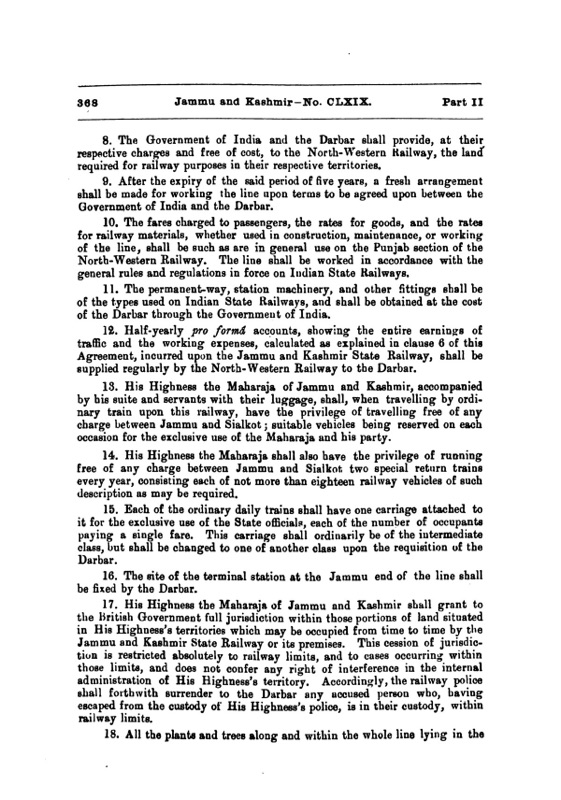
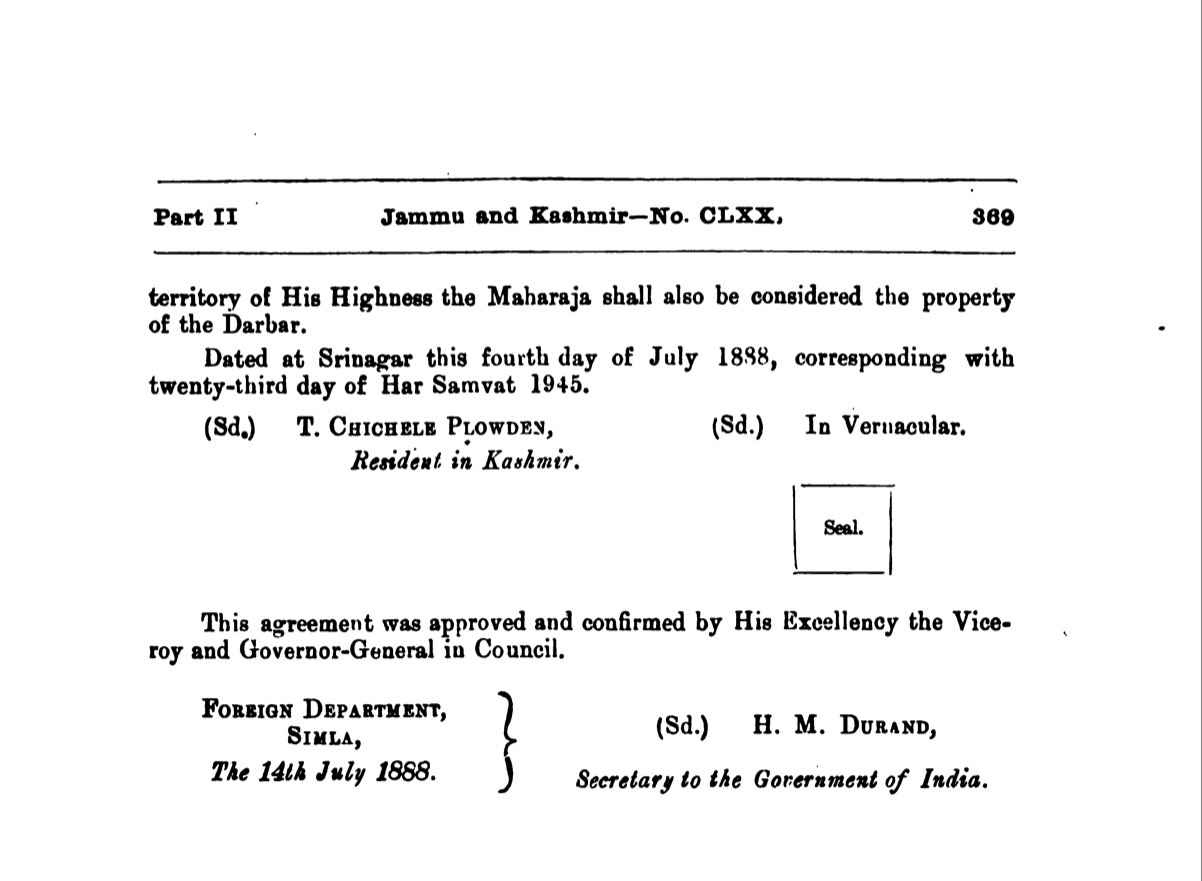
The first agreement, dated 14 July 1888, was formally concluded between the Government of India and His Highness Maharaja Partap Singh, and it was expressly described as being “relative to the construction of a railway to Jammu.” The opening clause gave the line its intended identity: it would be called the “Jammu and Kashmir State Railway.” That title deserves attention. It marked the project as belonging, at least in constitutional symbolism, to the princely state .
To name the line a state railway was not a trivial act. In the colonial world, naming could signify ownership, prestige, and political location. The line would be connected to imperial rail systems and operated according to British railway practice, yet it would still bear the identity of Jammu and Kashmir. It was a form of dual inscription: imperial in function, princely in designation. The title captured the paradox of princely modernity under empire. A state could modernise through institutions that strengthened its visibility while simultaneously tying it more closely to British power.
The agreement then moved from symbolism to engineering. It provided for a broad-gauge line of 5 feet 6 inches from Sialkot to the left bank of the Tawi at Jammu, with the estimate for the whole cost to be submitted to the Kashmir Darbar for sanction . Here one sees the balance the document tried to preserve. Technical planning was embedded in a process of princely approval. The Darbar was not bypassed; it was formally positioned as the authority whose sanction would validate the estimate. Even within an unequal system, form mattered.
The line was to be constructed by the Darbar through its Chief Engineer, Major-General de Bourbel, but according to the standard dimensions prescribed by the Government of India . This clause is among the most revealing in the entire agreement. It makes visible the hybrid character of the enterprise. The state would build, but empire would define the standards. Local agency existed, but within a technical universe set elsewhere. The railway would therefore enter Jammu and Kashmir not as a local experiment adapted to local norms, but as a component of a larger imperial system whose specifications were already fixed.
This is one of the most important insights the agreement offers. Infrastructure in princely India was often collaborative, but collaboration unfolded inside unequal frameworks. The Darbar’s role in construction signaled participation and investment. The Government of India’s role in prescribing standards signalled authority over the form modernity would take.
Capital, risk, and the original financial design
If the agreement’s construction clauses reveal the structure of power, its financial clauses reveal the structure of obligation. Under the original 1888 arrangement, the capital required for constructing the whole line was to be provided by the Darbar. This placed a remarkable burden on the princely state. Jammu and Kashmir was not merely consenting to a railway through its territory; it was expected to finance the enterprise in full, even though the line would run partly through British territory and would also serve wider imperial interests.
That provision is central to any serious reading of the railway’s history. It shows that the Dogra state was willing to commit major resources to connectivity. Historical accounts suggest that the Maharaja’s investment approached one million rupees, with some accounts placing it even higher. Whatever the precise figure, the scale of commitment was substantial, and it underlines the seriousness with which the state approached the project.
Yet the agreement did not leave the Darbar without compensation. It provided that the Darbar would receive from the Government of India interest at the rate of 4 percent per annum on the capital expended on the section of the line lying within British territory, counted from the date of payment. This is a clause of enormous historical interest. It acknowledges that one government was being asked to finance infrastructure located in the jurisdiction of another. The interest provision was therefore a device of fiscal fairness, or at least fiscal mitigation. It did not eliminate the asymmetry of the arrangement, but it recognised it.
There was also provision for additional works found necessary on the British section after first construction, with similar cost-recovery logic. This reinforces the point that the parties understood the line not as a static act of construction but as an evolving asset likely to require further expenditure. The agreement thus combined immediate finance with a framework for future contingencies.
Working the line: operation, maintenance, and profit
The 1888 agreement stipulated that the section of the line in Jammu territory would be leased to and worked by the North-Western Railway for five years from the date of opening. During this period, the North-Western Railway was to maintain the line in an efficient state and pay the Darbar one percent per annum on the capital expenditure of the Jammu section. After working expenses and that one percent payment were accounted for, the net earnings were to be divided equally between the North-Western Railway and the Darbar .
This was not a casual management contract. It was a carefully balanced operating regime. The Darbar, despite having financed construction, did not insist on direct operation. Instead, it accepted the working expertise of a major railway institution already embedded in British India. In return, it secured a fixed annual return and a share in net earnings. This arrangement blended caution and ambition. The state gained a railway without having to instantly create a full operating bureaucracy of its own, while still preserving a revenue interest in the line.
The involvement of the North-Western Railway also ensured integration with the practices of a major railway network. Timetabling, maintenance, staff deployment, accounting, and traffic management could be handled through an established system rather than improvised anew. For the British, this guaranteed order and standardization. For the Darbar, it offered competence and reliability, even if it came at the price of operational dependence.
The agreement further provided that after five years, if no fresh agreement were made, a new arrangement would be necessary for working the line. In effect, the project was placed on an initial lease-like footing, not a permanently fixed constitutional settlement. That gave both sides room to revisit terms once the line had proved itself—or disappointed expectations.
Fares, tariffs, and the economics of integration
A railway becomes real not only when it is built, but when its movement is priced. The agreement therefore went on to specify that passenger fares, freight rates, and the rates for materials used in the construction, maintenance, or working of the railway would be the same as those charged on the Punjab section of the North-Western Railway. This is a deceptively modest clause with major implications.
Uniformity of rates meant that the Jammu line would be economically legible within the broader rail system. Merchants, officials, and travelers would encounter a familiar tariff logic. It reduced the friction of administrative difference and prevented the line from becoming a pricing anomaly at the edge of the network. The state’s first railway was thus integrated not only physically but economically into the world of British Indian rail transport.
At the same time, this provision limited the space for the Darbar to use railway pricing as an autonomous policy instrument. Once again, the pattern is familiar. The state gained access to the benefits of an imperial system, but on terms that nudged it toward conformity with imperial practices.
The dignity of the ruler on a modern railway
Among the most memorable provisions of the 1888 agreement are those relating to the Maharaja’s travel privileges. His Highness, accompanied by his suite and servants, along with luggage, horses, and vehicles, was entitled to travel free of charge between Jammu and Sialkot by train in suitably reserved vehicles . The agreement also granted him the privilege of running special trains on that section under specified conditions, and one carriage on the daily train could be appropriated for the exclusive use of state officials, subject to certain rules .
These clauses are richly symbolic. Railways are usually associated with regularity, impersonal scheduling, and standardization. Princely rule, by contrast, depended on visible distinctions of rank and privilege. The agreement had to accommodate both worlds. The result was not the abolition of hierarchy, but its translation into railway form. The Maharaja would move within a modern transport system, yet not merely as an ordinary passenger. His sovereign dignity would travel with him.
For historians, these details matter because they show how technologies of uniformity were adapted to older political cultures of status. A railway might compress distance, but it did not flatten rank.
Jurisdiction on the rails
Perhaps the most constitutionally delicate clauses in the 1888 agreement concerned jurisdiction. The Maharaja granted the British Government full jurisdiction within those portions of land situated in his state that might from time to time be occupied by the railway and its offices, but the concession was expressly restricted to railway limits and did not authorize interference with the internal administration of the Maharaja’s territory beyond those limits . If any person escaped into railway limits from the custody of the Maharaja’s police, that person, if accused, was to be surrendered to the Darbar.
This is an extraordinary legal formula. It created a corridor of functional British jurisdiction inside a princely state while simultaneously insisting that the concession be read narrowly. The railway became, in effect, a strip of qualified administrative exception—an enclave of imperial working authority carved into princely territory for operational purposes.
Land, trees, and the material world of construction
The agreement also provided that land required for the railway in the territories of the respective parties would be given free of cost by those parties. Even more strikingly, the plants and trees along and within the whole line lying in the territory of His Highness the Maharaja were to be considered the property of the Darbar. Such details may appear small, but they remind us that railway history is always a history of landscape as well as law.
A railway required embankments, cuttings, station grounds, timber, access routes, and clear definitions of what belonged to whom. The agreement’s attention to plants and trees tells us how carefully the material environment of the line had to be incorporated into the legal settlement. Even vegetation had fiscal and administrative meaning.
This is one reason the agreement reads so powerfully today. It captures the railway not as an abstract emblem of progress, but as a physical intervention into land, property, and authority.
The supplementary agreement of 1890
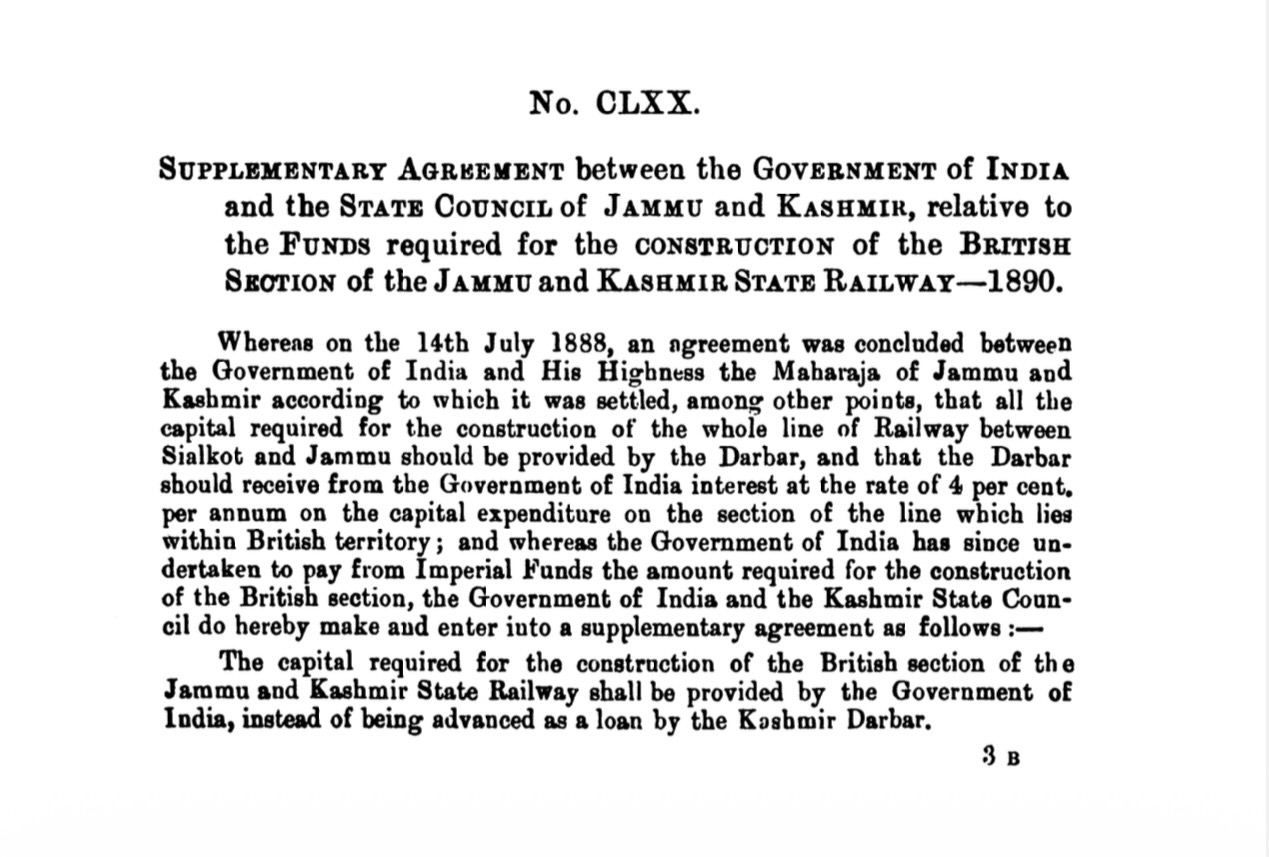
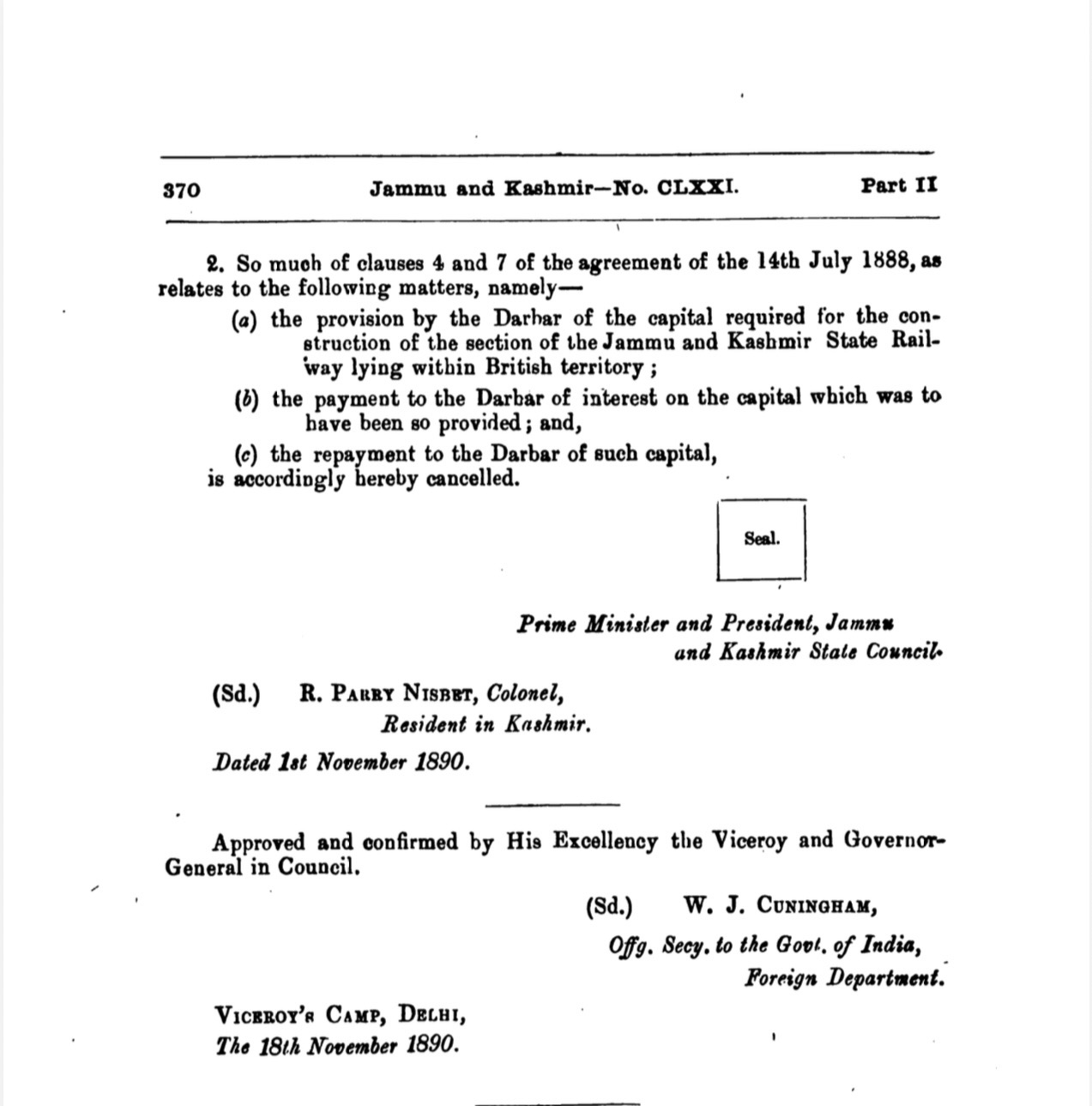
By 1890, the original financial design had been reconsidered. The supplementary agreement, concluded between the Government of India and the State Council of Jammu and Kashmir, recited that the 1888 agreement had provided for the Darbar to supply all the capital required for the whole railway, but that the Government of India had since undertaken to provide from Imperial Funds the amount required for constructing the British section of the line .
This revision is the hinge on which the documentary history of the railway turns. The supplementary agreement declared that so much of clauses 4, 7, and related provisions of the 1888 agreement as dealt with the provision by the Darbar of capital for the section in British territory, the payment of 4 percent interest on that capital, and the repayment of such capital, stood cancelled . In other words, the fiscal architecture of the project was simplified and rebalanced.
The importance of this change cannot be overstated. The 1888 arrangement had asked the Darbar to finance the entire line and then receive interest on the section lying in British territory. The 1890 agreement replaced that somewhat awkward formula with a cleaner principle: the British Government would finance the British section itself. What had initially been a cross-jurisdictional financing arrangement was brought into closer alignment with territorial responsibility.
Why did this happen? The documentary language itself does not elaborate at length, but the logic is clear enough. The original arrangement likely posed administrative inconvenience and perhaps political discomfort. It was one thing for the Darbar to invest in a railway that would bind Jammu more closely to the rail network. It was another for it to remain the capital provider for track and works situated in British India. The supplementary agreement corrected that imbalance without undoing the project itself.
From a historian’s perspective, this amendment reveals the pragmatism of colonial-princely governance. Agreements could be revised. Fiscal structures were not sacred if they proved impractical. What mattered was preserving the line while adjusting the burdens that sustained it. In that sense, the 1890 document was not a rupture but a refinement.
Construction and opening
Historical accounts indicate that work on the railway commenced in October 1888 and that the line was declared open for traffic on 13 March 1890. The Jammu–Sialkot line was about 27 miles long from Sialkot to Jammu, though some local accounts refer to the Jammu-region portion in different mileage terms depending on the segment measured. Built during the reign of Maharaja Partap Singh, it became the first railway line in the state of Jammu and Kashmir.
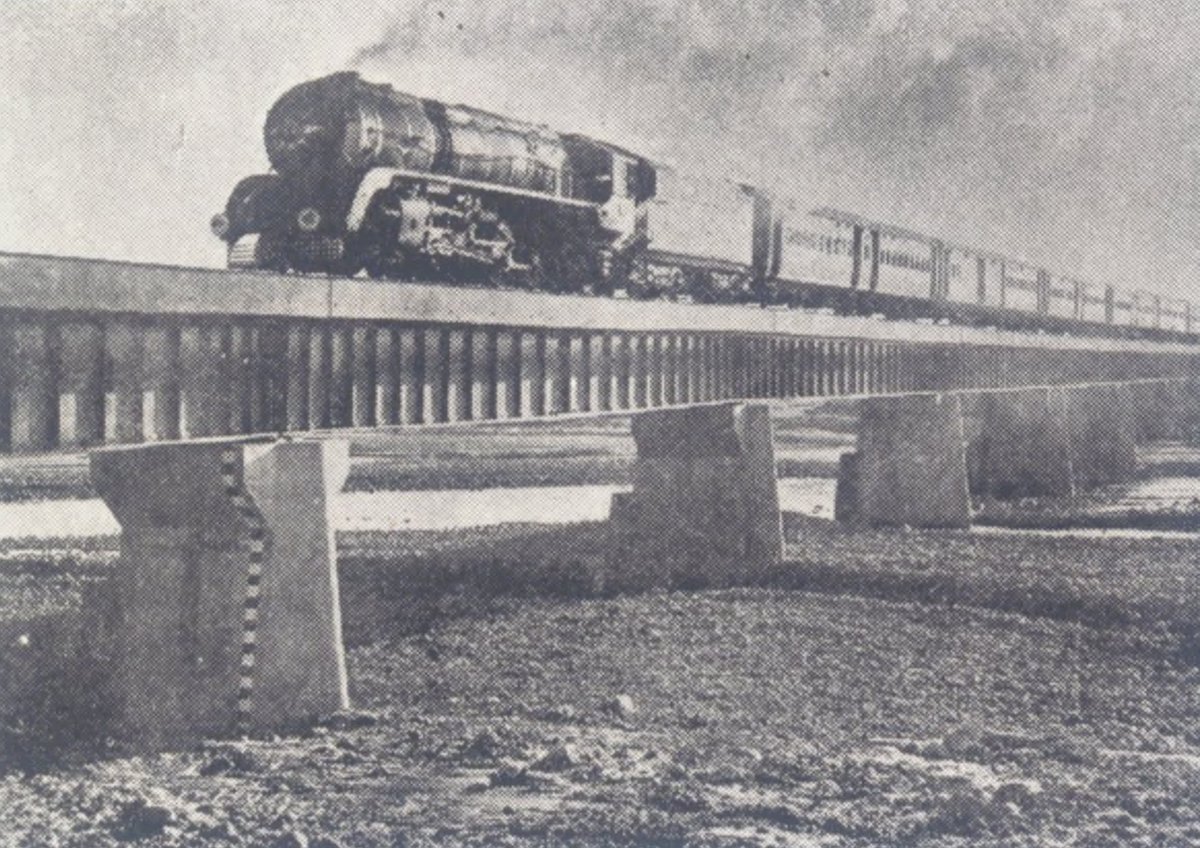
Reports also note technical contrasts in the material used: the section in Punjab is said to have been laid with lighter second-hand wrought iron rails, while the Jammu and Kashmir section used heavier new steel rails. Whether read as an engineering detail or as a clue to the allocation of investment, that distinction is suggestive. It may hint that the princely section was built with greater material solidity, perhaps reflecting the prestige attached to the line within the state or the specific terms under which expenditure was approved.
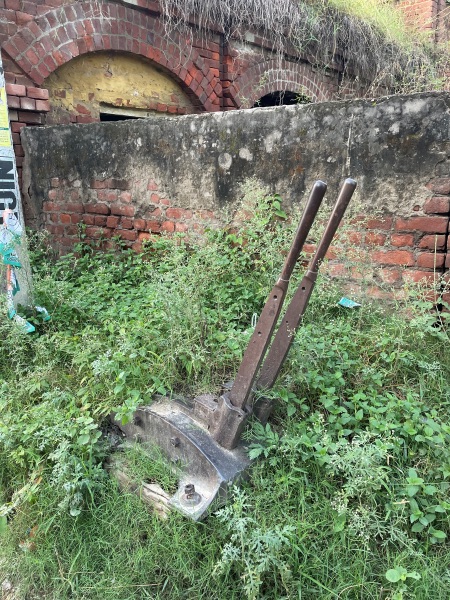
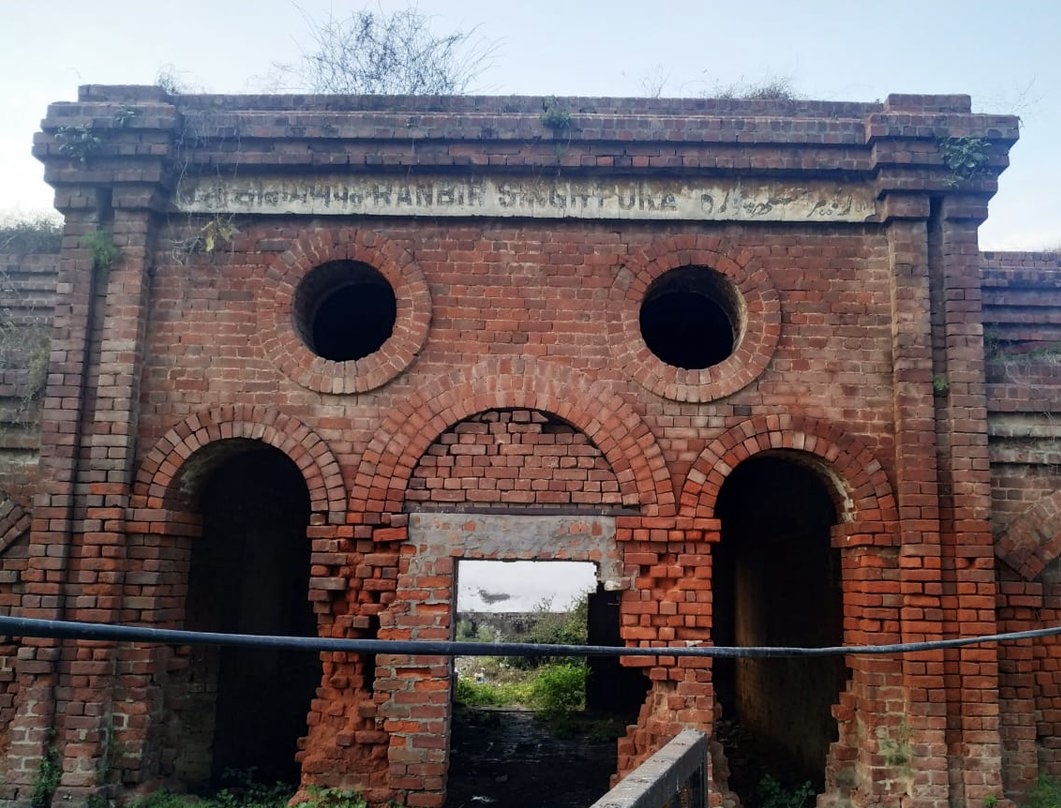
Once open, the line connected Jammu with the rail world of Punjab and beyond. Later timetable evidence shows regular passenger services and intermediate stations including Sialkot Cantonment, Suchetgarh, Ranbir Singh Pora, Miran Sahib, and Jammu Cantonment. The route crossed the boundary between British territory and the princely state just east of Suchetgarh, making Ranbir Singh Pora the first station on the state side. Even in this geography of stations, the political border remained visible.
A short line with a long significance
Measured only in miles, the Jammu–Sialkot line was modest. Measured in historical consequence, it was not. It altered how Jammu connected outward. It tied the state to the North Western Railway system and thereby to a much larger circulation of commerce, governance, and mobility. It also established a precedent: Jammu and Kashmir had entered the railway age.
This matters because infrastructure changes imagination. Once a state has a railway, however limited, questions of future extension follow almost automatically. Accounts of Maharaja Partap Singh’s reign note that wider schemes to connect the Kashmir Valley with the Indian railway system were considered, though they did not materialize in that period because of cost and difficulty. The Jammu–Sialkot line was therefore both an achievement and a beginning. It showed what was possible while exposing how much remained geographically formidable.
The line’s afterlife adds poignancy to its story. Service effectively ended in the upheaval of 1947, when Partition severed the route and the line fell into disrepair. A new rail approach to Jammu would later emerge through a different geography, culminating in the Pathankot–Jammu line in independent India. But the lost westward orientation of the older line remains historically significant. The first railway of Jammu and Kashmir linked the state not southward through the routes familiar today, but westward to Sialkot, in a world that Partition would destroy.
Reading the agreements as political texts
The enduring value of the 1888 and 1890 agreements lies in their ability to reveal the political anatomy of infrastructure. They show that railway construction in princely India was never merely a matter of engineering. It was also a matter of law, finance, and constitutional balance. The agreements had to answer questions that modern readers might otherwise overlook: Who owns a railway in a state that is not directly ruled by the colonial government? Who pays for the portion outside that state? Who works it? Who sets fares? What jurisdiction applies on railway land? How is princely dignity preserved inside a standardised transport regime?
Each answer in the Jammu case was shaped by compromise. The line was called the Jammu and Kashmir State Railway, but it was to be built to Government of India standards and worked by the North-Western Railway. The Darbar initially bore the capital burden for the whole line, yet the supplementary agreement later relieved it of financing the British section. The Maharaja retained prestige and privilege, yet railway land within his territory could be subject to British jurisdiction for railway purposes .
This is the grammar of indirect rule. Empire did not erase princely states; it reorganized their room for action. The railway agreements show that process in unusually concrete form.
The historian’s lesson
For modern readers, there is a temptation to treat old railway agreements as dry appendices to a story whose real drama lies elsewhere. That would be a mistake. In the case of Jammu and Kashmir, the agreements are the drama. They reveal the assumptions, anxieties, and ambitions that shaped the state’s first encounter with railway modernity.
They show a Dogra state willing to spend heavily for access to the future. They show a colonial government determined to fold that future into its own systems of standardization and control. They show both sides adapting to one another through documentary precision. And they show that when the first train finally ran to Jammu, it did so over a political settlement as carefully laid as the track itself.
The line has vanished from ordinary use, and much of its physical world belongs now to memory, borderland debris, and archival fragments. But the agreements remain. They preserve a moment when Jammu and Kashmir entered the age of steam through the language of clauses, calculations, and compromise. For that reason, they deserve to be read not as bureaucratic relics, but as foundational texts in the history of the region.
The railway to Jammu was a material fact. The agreements that brought it into being were something more: they were acts of historical design. Through them, a princely state negotiated its place in a transforming subcontinent. Through them, the British Empire advanced one more line of connection into the north. And through them, modern infrastructure announced itself in Jammu and Kashmir not only as iron on earth, but as authority made legible on paper.


Comments
Post a Comment