The Chib/Chibh Rajputs and Their Feudal Order
By Uday Veer Anthal
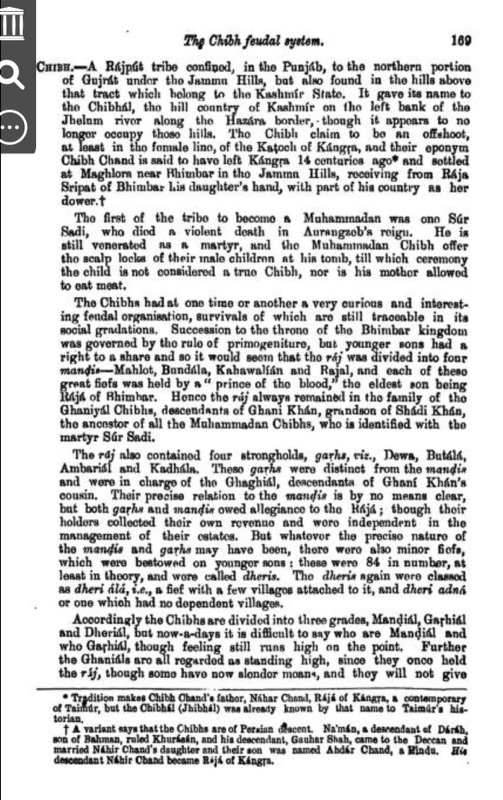
The historical landscape of the Duggar region is marked by layered identities, shifting allegiances, and localized systems of power that rarely find space in mainstream narratives. Among such overlooked communities are the Chibh Rajputs, once a dominant group inhabiting the tract between Bhimbar, the Jammu Hills, and the Hazara frontier.
A significant portion of our knowledge about them comes from colonial ethnographic compilations, particularly A Glossary of the Tribes and Castes of the Punjab and North-West Frontier Province by H. A. Rose. While such sources must be approached critically, they preserve invaluable details regarding the origins, social structure, and political organization of the Chibhs.
Geographical Location and Early Presence
The Chibhs are described as a Rajput tribe originally confined to the Punjab plains, especially around Gujrat. Over time, they expanded northwards into the hilly tracts adjoining Kashmir. These included areas along the left bank of the Jhelum River, forming what later came to be known as Chibhal—a region that derived its very name from this tribe.
Interestingly, although the Chibhs gave their name to this geographical zone, historical accounts suggest that they no longer occupied some of these areas at the time of writing, indicating earlier migration or displacement.
Lineage and Migration Traditions
The Chibhs traced their ancestry to the prestigious Rajput house of Kangra. According to tradition, their progenitor, Chibh Chand, migrated from Kangra approximately fourteen centuries ago. He is said to have settled near Bhimbar in the Jammu Hills, establishing a base that would later evolve into a politically significant domain.
This migration narrative is important not merely as a genealogical claim but as a reflection of how Rajput identity was constructed—often linking local ruling groups to older, prestigious lineages in order to legitimize authority.
Political Structure and the Bhimbar Connection
The Chibhs maintained a close association with the ruling establishment of Bhimbar, which functioned as a central authority in the region. However, unlike highly centralized monarchies, the Chibh political system reveals a more distributed form of governance.
Succession to rulership nominally followed the rule of primogeniture, whereby the eldest son inherited the throne. Yet, this principle was tempered by the inclusion of younger sons in the political framework. Rather than being excluded, they were granted shares in land and authority, resulting in a diffusion of power across multiple branches of the ruling lineage.
The Feudal Framework: Manjhas, Garhs, and Dheris
One of the most striking features of Chibh society was its multi-layered feudal organisation, which reflects both kinship ties and territorial control.
1. Manjhas (Major Divisions)
The kingdom was divided into four principal territorial units known as manjhas. Each was governed by a leading noble—typically a “prince of the blood”—belonging to the ruling family. This ensured that power remained within the lineage while still being regionally distributed.
2. Garhs (Fortified Strongholds)
In addition to the manjhas, there existed several garhs—fortified centers such as Deva, Butala, Ambarial, and Kadhala. These were controlled by collateral branches of the ruling house, often descendants of close relatives of the main line.
These garhs functioned as semi-autonomous units. While they owed allegiance to the Raja of Bhimbar, they exercised considerable independence in managing their estates and collecting revenue.
3. Dheris (Minor Fiefs)
At the lowest level were the dheris, smaller feudal estates granted primarily to younger sons. Numbering around eighty or more, these units varied in size—some comprising multiple villages, others limited to a single settlement.
Despite their relative insignificance, the dheris played a crucial role in maintaining the broader feudal structure, ensuring that even minor branches of the lineage retained a stake in the political order.
Religious Change and Cultural Continuity
The Chibh community also experienced religious transformation during the Mughal period, when sections converted to Islam. One prominent figure associated with this transition is Sur Sadi, who is believed to have died during the reign of Aurangzeb and was subsequently venerated as a martyr.
However, conversion did not erase earlier traditions. Practices such as offering the hair of male children at his tomb continued, reflecting a blending of older cultural customs with new religious identities. This syncretism highlights the gradual and complex nature of social change in the region.
Clan Organization: The Fourteen Septs
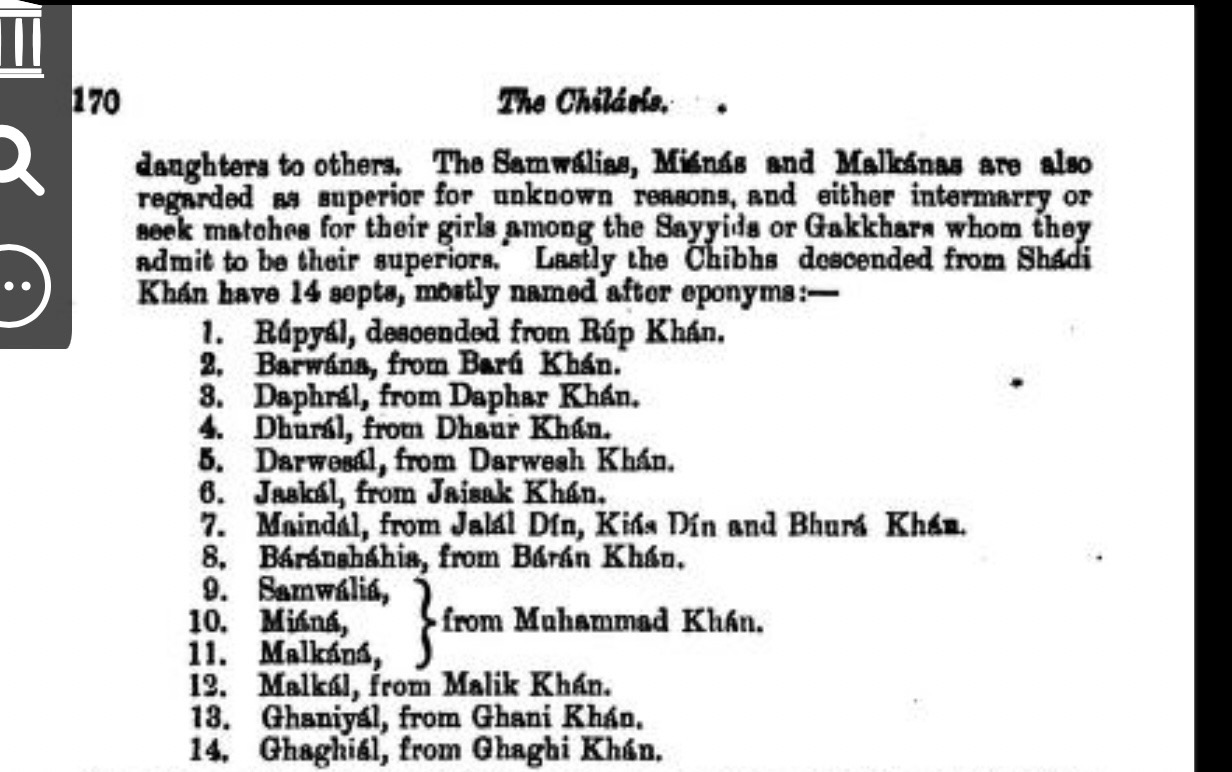
Beyond their territorial divisions, the Chibhs were internally organized into fourteen clans or septs, most of which derived their names from eponymous ancestors. These included:
Ropyal, Barwana, Daphal, Dhural, Darweshial, Jaskal, Manjdal, Baranshahia, Samwal, Minhas, Malkana, Malkal, Ghaniyal, and Ghagial.
These clans played a central role in regulating marriage alliances, maintaining social hierarchy, and structuring political relationships within the tribe. Certain groups, such as the Samwals, Minhas, and Malkanas, were regarded as socially superior and often sought marital alliances with Sayyids and Gakkhars, whom they acknowledged as higher in status.
Reassessing Colonial Knowledge
While the account of H. A. Rose provides valuable insights, it is essential to approach it with caution. Colonial ethnographies often sought to classify and rigidly define communities that were, in reality, fluid and dynamic.
Therefore, such works should be treated as important historical records shaped by their context, rather than definitive representations of social reality.
Conclusion
The Chibh Rajputs present a compelling example of a localized feudal system that combined kinship, territorial division, and shared authority. Their political organization challenges the notion of rigid centralization and instead reveals a model in which power was negotiated within a ruling lineage.
Although this system has long since faded, its traces survive in regional memory, clan identities, and historical records. Reconstructing such histories is crucial—not only for understanding the past but also for appreciating the complexity of political and social life in the Jammu hills.


Comments
Post a Comment